
Hyperloop Technology and Virgin Hyperloop’s Projects in India
- Dec 28, 2020
- 2 min read
Redefining travel
-Abhishek Pathak
Engineering Department, UG1
‘Hyperloop’ is the fifth and the fastest mode of transportation in the near future. This hypothetical mode of transportation is named Hyperloop as it would go in the tube at hypersonic speed. In the 18th century, British Engineer George Medhurst detailed his idea of transporting goods in airtight tubes using air propulsion in a book. This idea jumped to the 21st century with some modifications when a group of engineers from Tesla and SpaceX started working on the concept of Hyperloops with every detail of potential design, function, pathway, and the cost of the system.
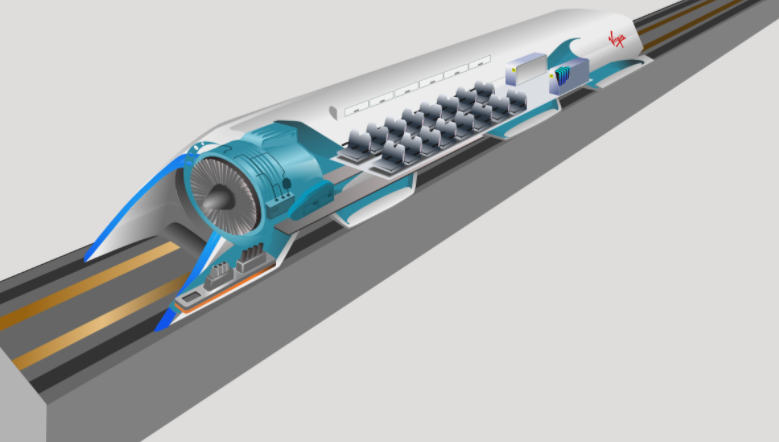
The Hyperloop concept operates by sending ‘capsules’ or ‘pods’ through a steel tube maintained at a partial vacuum. This concept resembles that of the Vactrain System but operates at approximately 1 millibar (100 Pa) of pressure. The Vactrain concept theoretically eliminates obstacles like friction and air resistance, to a much greater extent. This is done by employing magnetically levitating trains in evacuated or partially evacuated tubes. According to Elon Musk, for the Hyperloop concept to work on earth, low-pressure tubes are required. However, if they were to be built on Mars, the lower air resistance would allow a Hyperloop to be created without tubes, only track.
In this open-source project of Hyperloop technology, the Virgin Hyperloop firm has made tremendous growth within a few years. From conducting a first live trial in 2016 to conducting human trials in 2020, it has indeed come a long way. In India, Hyperloop One along with the Government of Maharashtra is set to create the first Hyperloop system in the world between Pune and Mumbai.
Hyperloop Transportation Technologies are also in the process of signing a letter of intent with the Government of India for a proposed route between Chennai and Bengaluru, where the distance of 345 km will be covered in only 30 minutes! HTT also plans for a route between Amravati and Vijaywada which would only be a 6-minute ride. An Indore based firm Dinclix Ground Works ‘DGW Hyperloop’ advocates a Hyperloop corridor between Mumbai and Delhi via Indore, Kota, and Jaipur.
Some critics focus on the unpleasant experience of riding in a narrow, sealed, and windowless capsule inside a steel tunnel, also the hypersonic speed is subjected to significant acceleration forces. Even if the tube is initially smooth, the ground may shift with seismic activity. At such high speeds, a minor deviation from a straight path may lead to serious consequences. Also, the extra cost in this project attracts the critics as other maglev trains are already in use which is at a sustainable cost and time, both like the one used in Japan called ‘SC Maglev’.
In response to the critics, various firms assume that Hyperloop could be built along an existing road (or rail network), which would reduce the very high cost of land acquisition. Also, increasing global networking always demands the fastest means of transportation, so the practical use of this technology may satisfy these demands and could reduce the illusion of being far apart from people within the country. It can be seen as a major step to connect all the world in the concept of ‘One Family’.
Comments