
SCIENCE IN ANCIENT INDIA: 7 FACTS TO BLOW THE MIND
- Nov 1, 2021
- 3 min read
Sandipan Hazra
Physics department
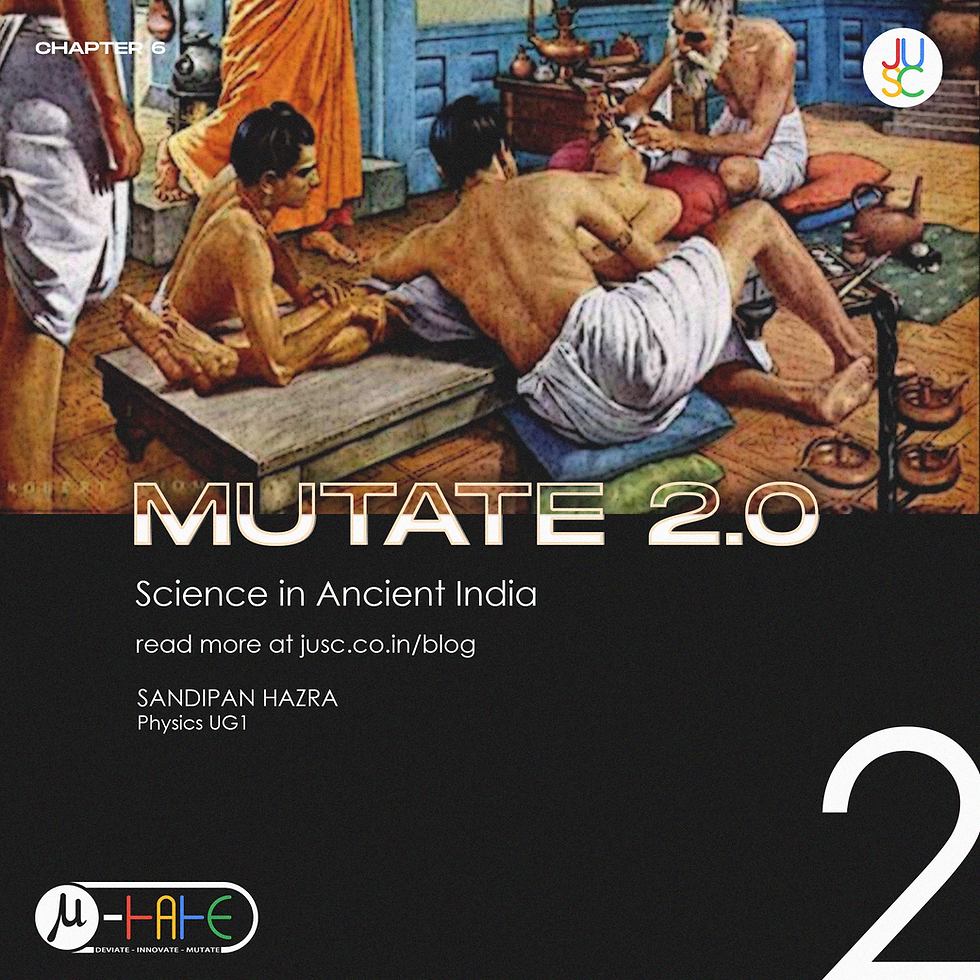
We are mostly aware of the latest and new invention and development of the science of recent times in some sense. But do we know much about the science in ancient India? Many of us can think they couldn't have such a science background. But this is not true. Here I intend to share some of the unbelievable facts on science of that ancient time. Let's start-
1...Let's start with our planet earth. There are many words in Sanskrit(this language is about 10,000-12,000 years old) to describe the earth. If we focus on two specific words "Bhugol" and "Jagat", these two words tell us many things. "bhu" stands for 'earth' and "gol" means 'spherical'. so the word means 'earth is spherical'. And the word "Jagat" means 'that which moves, which basically tells earth is always moving. So, our ancestors know(long before the West discovered it) that the earth is spherical and continuously moving and these are clear from the very nomenclature.
Also, many Indian geological texts describe the earth as being supported by eight tortoises. The analogy of the tortoises stands for the eight solid tectonic plates on the earth’s crust over the molten core of the earth, which are constantly moving but very slowly, like a tortoise.
2...Our ancestors had also figured out how to make rustproof irons. There is a pillar made of iron in front of Qutub Minar known as the "Iron Pillar of Delhi" which is rustproof. Even the terrible pollution of Delhi can't make the pillar rusty. And there are many such small pillars of that time spread across India, which suggests this technique of making rustproof iron was very common even to ordinary people.
3...They also approximately knew the speed of light which is mind-boggling. In a sloka(mentioned in sources) of sun salutation, it is mentioned: "the traveler of 2,202 yojanas in half a nimisha" where 1 yojana=12.87 km and 1 nimisha=0.2112 second.
So, the sloka is telling that light takes about 1/2 nimisha(=0.1056 sec)to travel 2202 yojana(=28339.74 km). Thus calculating we can find the speed of light to be 268,368,750 m/s, which is close to the actual speed of light.
4...In one sloka of Hanuman Chalisa, it states "Sun is at the distance of yuga shastra yojan"
where 1 yuga=12,000 celestial years, 1 sahastra=1000 and 1 yojan=12.87 km. So, the distance between sun and earth is=(12,000*1000*12.87) km=15.4 crore km, which is remarkably close to the actual average distance according to modern science.
5...Lalacharya in his work, ‘Sishyadhi vrudhi tanta’ spoke of the seven atmospheric layers as avaha, pravaha, udhwaha, samvaha, suvaha, parivaha and paravaha. Thousands of years later, modern science recognized these as the exosphere, ionosphere, thermosphere, mesosphere, stratosphere which contains the ozone layer.
6...Interestingly, the concept of gravity was understood by ancient Indians 5,000 years ago! For instance, the Rig Veda-1-103-2 explains: “The gravitational effect of Solar System keeps the earth stable.”
7...our ancestors also knew the physics of optics. In "Bruhatsamhita--chapter 35", states "the multicolored rays of the Sun, being dispersed in a cloudy sky, are seen in the form of a bow, which is called the rainbow".And our modern science also tells us the almost same thing about dispersion.
To conclude I want to say that our Indian ancestors had a great knowledge of science, but how did they know all these things? this is the question on which we should think...
sources:: 1) https://youtu.be/y7ELIegItxY
Comments